My child hates math. What helps?
Math anxiety shows up as early as 1st grade, and parents make it better or worse without noticing. This is what the research says works.
 By Lionel Mora · · 5 min read
The short answer
Most kids who say they hate math are anxious about it, and math anxiety shows up as early as 1st and 2nd grade. Anxiety eats the working memory kids need to solve problems, so they do worse, and that makes them more anxious. What helps: talk about math in everyday life (in a study of a bedtime math app, kids who used it often gained about three months of math learning in a year), use objects and drawings, praise strategy over speed, keep practice short and regular, and watch your own feelings: a parent's math anxiety rubs off when they help with homework a lot.
- "I hate math" usually means "math makes me feel stupid".
- Anxiety eats working memory, and math runs on working memory.
- If math makes you anxious too, help with homework less and talk about everyday math more.
- Speed drills and timed tests feed anxiety in some kids. Talking about strategy calms it.
- Ten calm minutes a day beats one long battle a week.
It usually starts small. A sigh when the math worksheet comes out. "I'm just bad at math." Then tears at the kitchen table, and you're not sure whether to push, help or back off. A lot of parents end up at that table. The research on what to do there is more practical than you'd think.
"I hate math" usually means "math makes me feel stupid"
Few kids hate numbers. They hate the feeling of not getting it while everyone else seems to. Math makes that feeling more likely than most subjects because it stacks. A shaky skill in 1st grade, like addition facts, quietly makes 2nd grade harder. By 3rd grade, multiplication is sitting on a wobbly base. Add timed tests and comparing with classmates, and difficulty turns into dread.
That dread has a name: math anxiety. Teenagers aren't the only ones who get it. Researchers found it in 1st and 2nd graders, and it was linked to lower math achievement1.
Why anxiety makes math harder
Math leans hard on working memory: holding "carry the one" in your head while you do the next step. Anxiety fills that working memory with worry. In the study of 1st and 2nd graders, the link between anxiety and lower scores was strongest in kids with good working memory, the ones who use it for more advanced strategies1. So an anxious kid does worse. That proves to them they're "bad at math". Which makes them more anxious, and round it goes. That loop is what you're trying to break.
The parent effect nobody mentions
This one is uncomfortable. In a 2015 study of 438 1st and 2nd graders, children of math-anxious parents learned less math over the school year and got more anxious themselves, but only when those parents helped with math homework often2. Anxious parents who helped less didn't have that effect. There was no link to reading.
So keep helping, but watch how. Sighing at fractions, saying "I was never a math person either", explaining the method impatiently: your kid learns something from all of it, and it isn't math.
The same research group found something encouraging too. Families used a simple app with one short math story and question a night. Kids who used it often gained about three months of extra math learning over the year, and the biggest gains went to children of math-anxious parents3. Other researchers have questioned how big that effect is, but the direction is consistent: relaxed, everyday math talk helps.
What helps
1. Talk about math outside of homework
How many minutes until dinner? If we double the recipe, how much flour? Big box or small box, which is better value? How many points do you need to win? Kids whose families talk about numbers more tend to understand numbers better7. Everyday math has no grade, no clock and no red pen. That's exactly what an anxious kid needs.
2. Make it visible
Counters, Lego, coins, drawings, a number line on the fridge. A meta-analysis of 55 studies found that teaching math with concrete objects beats symbols alone, especially for how much kids remember later. One condition: an adult has to help connect the objects to the math4.
3. Praise strategy, not speed
"How did you figure that out?" beats "Quick, what's 7 x 8?" Speed drills work for some kids and terrify others. A child who can tell you 7 x 8 is 7 x 4 doubled has something that lasts longer than a fast answer.
4. Get the level right
Too hard creates anxiety. Too easy creates boredom. A useful rule of thumb is to aim for kids getting about 85% of problems right, so they're stretched but mostly succeeding. That number comes from mathematical models of learning, not classroom trials8, but it matches what good teachers do by feel. If your child gets most problems wrong, step back a level, even if it's "below grade". Confidence comes back before speed does.
5. Treat mistakes as information
When they get it wrong, ask how they got there before you correct anything. The reasoning is often nearly right, and finding the slip themselves counts as a win. Our 7 + 4 example shows what this looks like.
6. Use "yet", but don't expect miracles
"You can't do this yet" is a good habit. The growth mindset research is more modest than the classroom posters: effects are small overall, and biggest for struggling students56. The words work best when your kid also gets to feel themselves improving.
7. Keep it short and regular
Ten calm minutes most days beats an hour of tears on Sunday. Stop while it's still going well.
What to avoid
- "I was bad at math too." It sounds kind. What they hear is that math ability runs in the family and can't change.
- Doing the problem for them to stop the tears. That ends tonight's tears and sets up tomorrow's.
- Comparing them with siblings or classmates.
- Math as a punishment ("extra worksheets if you misbehave").
When to get extra help
Talk to your child's teacher if math anxiety is causing stomach aches or school refusal, if your child is far behind grade level (our grade-by-grade guide lets you check), or if the struggle keeps going despite help. Persistent trouble with basic number sense can be a sign of dyscalculia, and schools can assess for it.
Where Marble fits
Marble is the interactive learning world we build for kids aged 6 to 12. Today it's about science, making things, creativity and social skills, not math worksheets. It runs on the same ideas as this article, though. When a kid gets something wrong, the characters come back with a smaller question, not a red cross. And each quest aims just past what your child has already mastered, so they're stretched but mostly succeeding.
Questions parents ask
Why does my child hate math?
Usually because math makes them feel like they're failing. Math builds on itself, so a gap in an earlier skill (addition facts, place value) makes every new topic harder. Timed tests, comparing with classmates and tense homework sessions turn that difficulty into anxiety, and anxiety makes the math harder still.
Can a 6 or 7-year-old have math anxiety?
Yes. Ramirez, Beilock and colleagues found math anxiety in 1st and 2nd graders, and it was linked to lower math achievement. The link was strongest in kids with good working memory, who rely on it most for advanced strategies.
Should I stop helping with math homework?
Not necessarily. But if math makes you anxious, change how you help. A 2015 study found children of math-anxious parents learned less math over the school year only when those parents helped with homework often. Ask questions instead of explaining, stay calm about mistakes, and lean on everyday math talk.
Does growth mindset help with math?
A little, and mostly for kids who are struggling. A large meta-analysis found growth mindset interventions have small effects overall, and a national study of 9th graders found modest gains for lower achievers. Tell your child they can get better with practice. It works best when they also get real wins at the right level.
How can I make math fun for my child?
Find the math in what they already love: game scores, recipes, building, money for something they want, sports stats. Play board games with dice and counting. Ask a puzzle question at dinner. Let them be wrong with no consequence. Fun tends to follow feeling capable.
Sources
- Ramirez, Gunderson, Levine and Beilock (2013), Math anxiety, working memory and math achievement in early elementary school
- ScienceDaily: Parents' math anxiety can undermine children's math achievement (Maloney et al., 2015)
- ScienceDaily: Bedtime math app boosts kids' achievement (Berkowitz et al., 2015, Science)
- Carbonneau, Marley and Selig (2013), A meta-analysis of the efficacy of teaching mathematics with concrete manipulatives
- Sisk et al. (2018), To what extent and under which circumstances are growth mind-sets important to academic achievement? Psychological Science
- Student Experience Research Network: Results from the National Study of Learning Mindsets (Yeager et al., 2019, Nature)
- Levine et al. (2010), What counts in the development of young children's number knowledge? Developmental Psychology
- Wilson et al. (2019), The eighty five percent rule for optimal learning, Nature Communications
Keep reading
 What your child should know in math, grade by grade (K to 5)The big ideas and the facts to know by heart for each year of elementary school, in plain English, with a quick way to check each one at home.
 The zone of proximal development, explained for parentsThe most useful idea in learning science is about a hundred years old. It explains why some homework help works and some ends in tears.
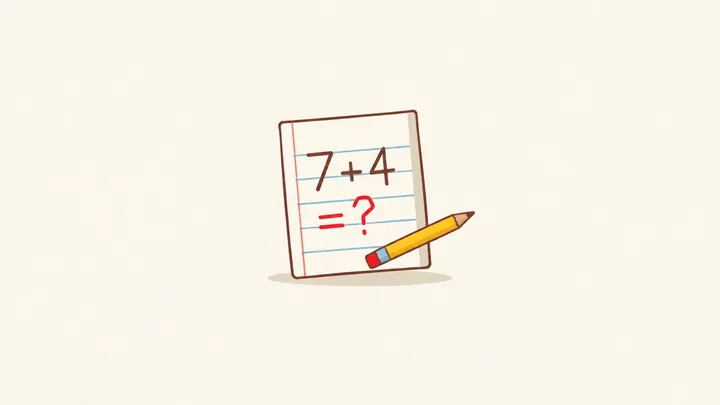 ChatGPT gives kids the answer. Here is what helps them thinkWe asked ChatGPT and Bowie, a character built for kids, the same question: how much is 7 + 4? The gap between the two replies is the whole problem with AI homework help.