What your child should know in math, grade by grade (K to 5)
The big ideas and the facts to know by heart for each year of elementary school, in plain English, with a quick way to check each one at home.
 By Lionel Mora · · 6 min read
The short answer
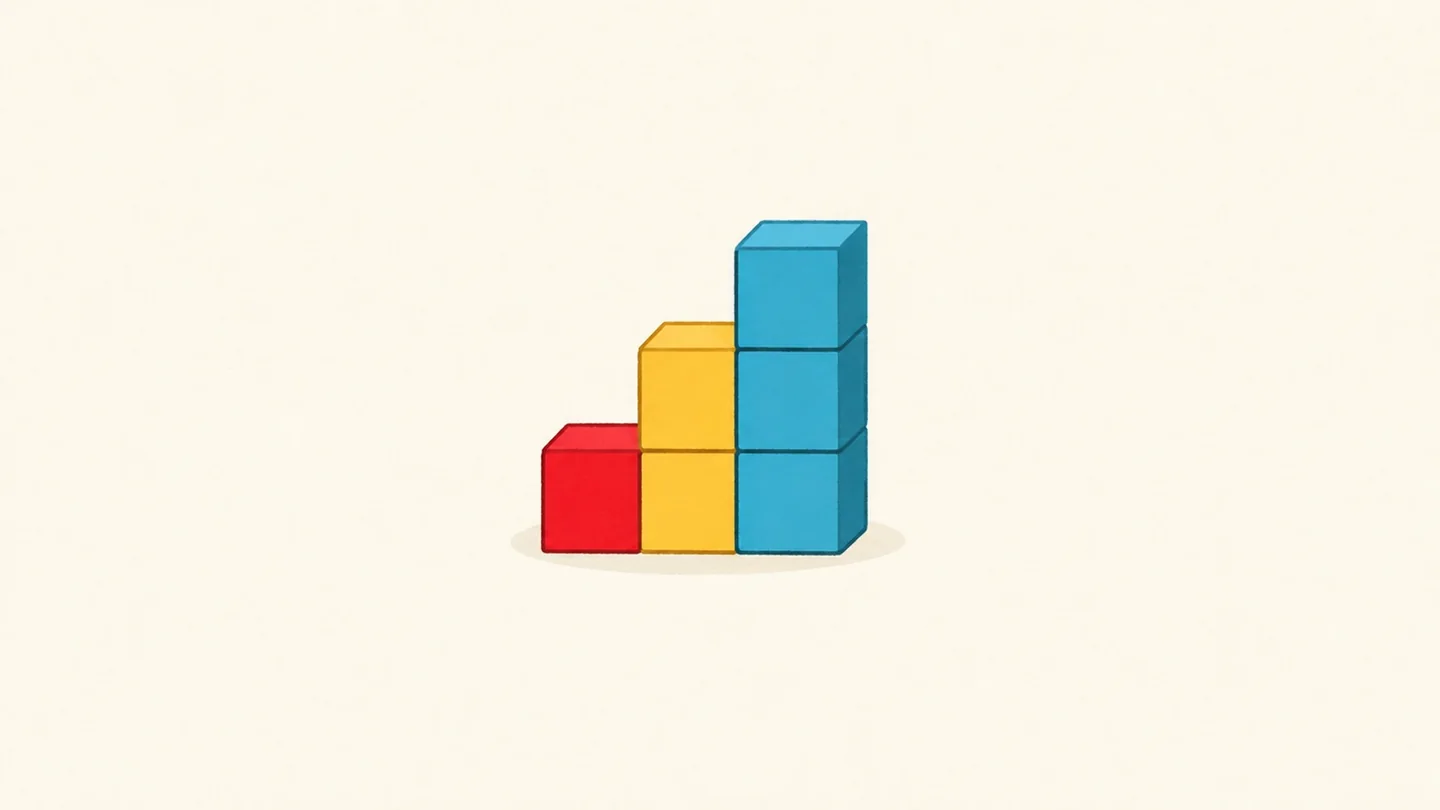
This is what most US standards expect by the end of each grade. Kindergarten: count and compare numbers, and add and subtract within 5 fluently. 1st grade: add and subtract within 20 (fluent within 10) and understand tens and ones. 2nd grade: know all single-digit sums by heart, and add and subtract within 100. 3rd grade: know all single-digit times tables (up to 9 x 9) by heart, and start fractions. 4th grade: multi-digit multiplication and division, and equivalent fractions. 5th grade: add and subtract fractions fluently, decimals to hundredths, and volume.
- Two memory milestones matter most: all addition facts by the end of 2nd grade, all multiplication facts by the end of 3rd.
- Fractions arrive in 3rd grade, and that's where a lot of kids first get lost.
- Most states follow Common Core or something close to it. Texas, Virginia, Florida and a few others use their own standards.
- In 2024, 39% of US 4th graders scored proficient in math on the national test.
Report cards say "approaching standard" or "meets expectations", and most parents have no idea what the standard is. This guide translates it. It follows the Common Core State Standards for Mathematics, which most states use directly or under another name10. If your state has its own (Texas, Virginia and Florida do, among others), the big ideas by grade are very similar.
For each grade you get the big ideas, what kids should know by heart, and a quick way to check at home.
Kindergarten math
Big ideas: counting, showing and comparing whole numbers (with objects first), and describing shapes and space. The standards say kindergarten should spend more time on number than on anything else1.
- Count to 100 by ones and by tens.
- Count a group of objects and know the last number said is "how many".
- Compare two groups and say which has more.
- Add and subtract within 10 with objects and drawings.
- By heart: add and subtract within 5 fluently (K.OA.A.5).
1st grade math
Big ideas: addition and subtraction strategies within 20, tens and ones (place value), measuring length, and putting shapes together to make new ones2.
- Add and subtract within 20 with strategies like counting on, making ten and doubles.
- Know that 37 is 3 tens and 7 ones.
- Add a two-digit number and a one-digit number, or a multiple of ten, within 100.
- Tell time to the hour and half hour.
- By heart: add and subtract within 10 fluently (1.OA.C.6).
2nd grade math
Big ideas: place value to 1,000, fluent addition and subtraction within 100, standard units of measurement, and describing shapes3.
- Read, write and compare numbers to 1,000.
- Add and subtract within 100 fluently, and within 1,000 using place value.
- Measure in inches, feet, centimeters and meters.
- Tell time to five minutes, and solve problems with dollars and cents.
- By heart: every sum of two one-digit numbers, like 7 + 8 and 9 + 6, by the end of the year (2.OA.B.2)7.
3rd grade math
Big ideas: multiplication and division within 100, fractions (especially unit fractions like 1/4), area, and two-dimensional shapes4.
- Understand multiplication as equal groups and arrays.
- Understand division as sharing, and as multiplication run backwards.
- See fractions as numbers on a number line, and compare simple fractions.
- Find area by counting squares, then by multiplying.
- Add and subtract within 1,000 fluently.
- By heart: every product of two one-digit numbers by the end of the year (3.OA.C.7)8.
4th grade math
Big ideas: multi-digit multiplication and division, equivalent fractions and adding fractions with the same denominator, and sorting shapes by their properties5.
- Multiply a number of up to four digits by a one-digit number, and multiply two two-digit numbers.
- Divide numbers of up to four digits by a one-digit number, with remainders.
- Recognize equivalent fractions (2/4 = 1/2) and compare fractions.
- Add and subtract fractions with the same denominator, and multiply a fraction by a whole number.
- Understand decimals to hundredths.
- Fluently: add and subtract multi-digit numbers with the standard algorithm (4.NBT.B.4).
5th grade math
Big ideas: adding and subtracting fractions with different denominators, multiplying and dividing fractions in simple cases, dividing by two-digit numbers, decimals to hundredths, and volume6.
- Add and subtract fractions with unlike denominators (1/2 + 1/3).
- Multiply fractions, and divide unit fractions by whole numbers.
- Add, subtract, multiply and divide decimals to hundredths.
- Find the volume of a rectangular box.
- Plot points on a coordinate plane.
- Fluently: multiply multi-digit whole numbers with the standard algorithm (5.NBT.B.5).
The whole picture in one table
| Grade | Must know by heart | The big new idea |
|---|---|---|
| K | Add and subtract within 5 | Counting and comparing quantities |
| 1st | Add and subtract within 10 | Tens and ones |
| 2nd | All single-digit sums | Place value to 1,000 |
| 3rd | All single-digit products (times tables) | Multiplication, division, fractions |
| 4th | Multi-digit addition and subtraction | Equivalent fractions, multi-digit multiplication |
| 5th | Multi-digit multiplication | Fractions with unlike denominators, decimals, volume |
How US kids are doing
On the 2024 National Assessment of Educational Progress, 39% of 4th graders scored at or above proficient in math. That's up from 2022 but still below 2019, and 24% scored below basic9. Most of the gains came from middle and higher performers. The lowest performers didn't improve. So if your child is struggling, they're far from alone, and the earlier you find the gap, the easier it is to close.
For comparison, kids in England are expected to know their times tables up to 12 x 12 by the end of Year 4, and they take a national multiplication check that year11.
How to help at home without worksheets
- Talk math in daily life: prices at the store, recipes, how long until dinner, splitting snacks fairly.
- Go back before you go forward. If 3rd grade multiplication is hard, check 2nd grade addition facts and place value first.
- Ask how, not just what. "How did you get that?" builds strategy. Our 7 + 4 example shows it.
- Little and often. Ten minutes a day beats an hour on Sunday.
- Watch the feelings. If math has turned into a fight, read how to help a child who hates math.
We use the same idea at Marble, the interactive learning world we build for kids aged 6 to 12. Its quests are about science, making things, creativity and social skills, and each one is pitched just past what that child has already mastered, so it lands at the right level instead of at random.
Questions parents ask
What math should a 2nd grader know?
By the end of 2nd grade, kids are expected to know from memory every sum of two one-digit numbers (like 7 + 8), add and subtract within 20 with mental strategies, and add and subtract within 100 fluently using place value. They also work with numbers to 1,000, measure length in standard units, tell time to five minutes and count money.
When should kids know their times tables?
Common Core expects kids to know every product of two one-digit numbers (up to 9 x 9) from memory by the end of 3rd grade. England's national curriculum goes further: times tables up to 12 x 12 by the end of Year 4.
What if my child is behind in math?
Find the earliest gap instead of drilling the current grade. Most struggles in later grades go back to place value, addition facts or fractions. Practice a little every day, use objects and drawings, talk about math in everyday life, and ask the teacher which skills to work on first.
Does my state use Common Core math?
Most states use the Common Core math standards or close versions of them, sometimes under another name. Some states never adopted them or replaced them, including Texas (TEKS), Virginia (SOL), Florida (B.E.S.T.), Indiana, Oklahoma and South Carolina. The big ideas by grade are similar across states.
What is the hardest grade for math in elementary school?
Many teachers say 3rd and 4th grade. Multiplication, division and fractions arrive together, and kids have to move from counting-based strategies to place value and multiplicative thinking. Solid addition facts and a real grasp of place value before 3rd grade make that jump much easier.
Sources
- Common Core State Standards: Kindergarten math introduction
- Common Core State Standards: Grade 1 math introduction
- Common Core State Standards: Grade 2 math introduction
- Common Core State Standards: Grade 3 math introduction
- Common Core State Standards: Grade 4 math introduction
- Common Core State Standards: Grade 5 math introduction
- Common Core State Standards: Grade 2 Operations and Algebraic Thinking (2.OA.B.2)
- Common Core State Standards: Grade 3 Operations and Algebraic Thinking (3.OA.C.7)
- The Nation's Report Card: 2024 NAEP mathematics, grade 4
- The 74: Fifteen years later, Common Core math endures in many states (2025)
- UK Department for Education: Multiplication tables check attainment
Keep reading
 My child hates math. What helps?Math anxiety shows up as early as 1st grade, and parents make it better or worse without noticing. This is what the research says works.
 How to homeschool an elementary-age child: a practical guideLaws, hours, curriculum, apps and money: what you need to know before you start homeschooling a 6 to 12-year-old.
 ChatGPT gives kids the answer. Here is what helps them thinkWe asked ChatGPT and Bowie, a character built for kids, the same question: how much is 7 + 4? The gap between the two replies is the whole problem with AI homework help.